
Engineering
Built for the edge. Designed for trust.
This is a high-level look at how PRESSA is being engineered. We share enough to be useful — and protect the details that make it real. If this is the kind of problem you want to work on, we want to talk.
Design philosophy
Three principles we will not compromise.
Safety first, always
Every subsystem is designed to fail toward a safe state. Redundancy is not a feature — it is the baseline.
Disposable meets reusable
The parts that touch the patient are single-use. The parts that control the system are built to last.
Complexity under the hood
The responder should think less, not more. Hard problems are solved in hardware, firmware, and signal processing.
01 · Pressure control
A closed loop between the responder and the patient.
The core challenge is not just applying pressure. It is applying the right pressure, maintaining it, and adjusting instantly when conditions change.
PRESSA's pressure control system is built around a fast feedback loop: sensing, actuation, and safety logic running in real time. The responder sets the objective. The system manages the rest.
Fail-safe behavior is embedded at every layer: loss of power, disconnection, or abnormal readings default to a visible, safe state.
02 · Architecture
One controller. Many situations. One clean separation.
The system is split into two worlds: a reusable controller that stays with the responder, and a disposable head that stays with the patient. This separation simplifies sterilization, reduces cost per use, and keeps the most complex electronics in a durable, upgradeable housing.
Disposable head
The patient-facing pressure interface. Designed for single use, sterile packaging, and predictable mechanical behavior.
Reusable controller
The durable brain and power source. Runs the control loop, manages telemetry, and enforces safety interlocks.
Wireless bridge
Low-power telemetry between controller and responder display. No wires across the patient. No cloud dependency.
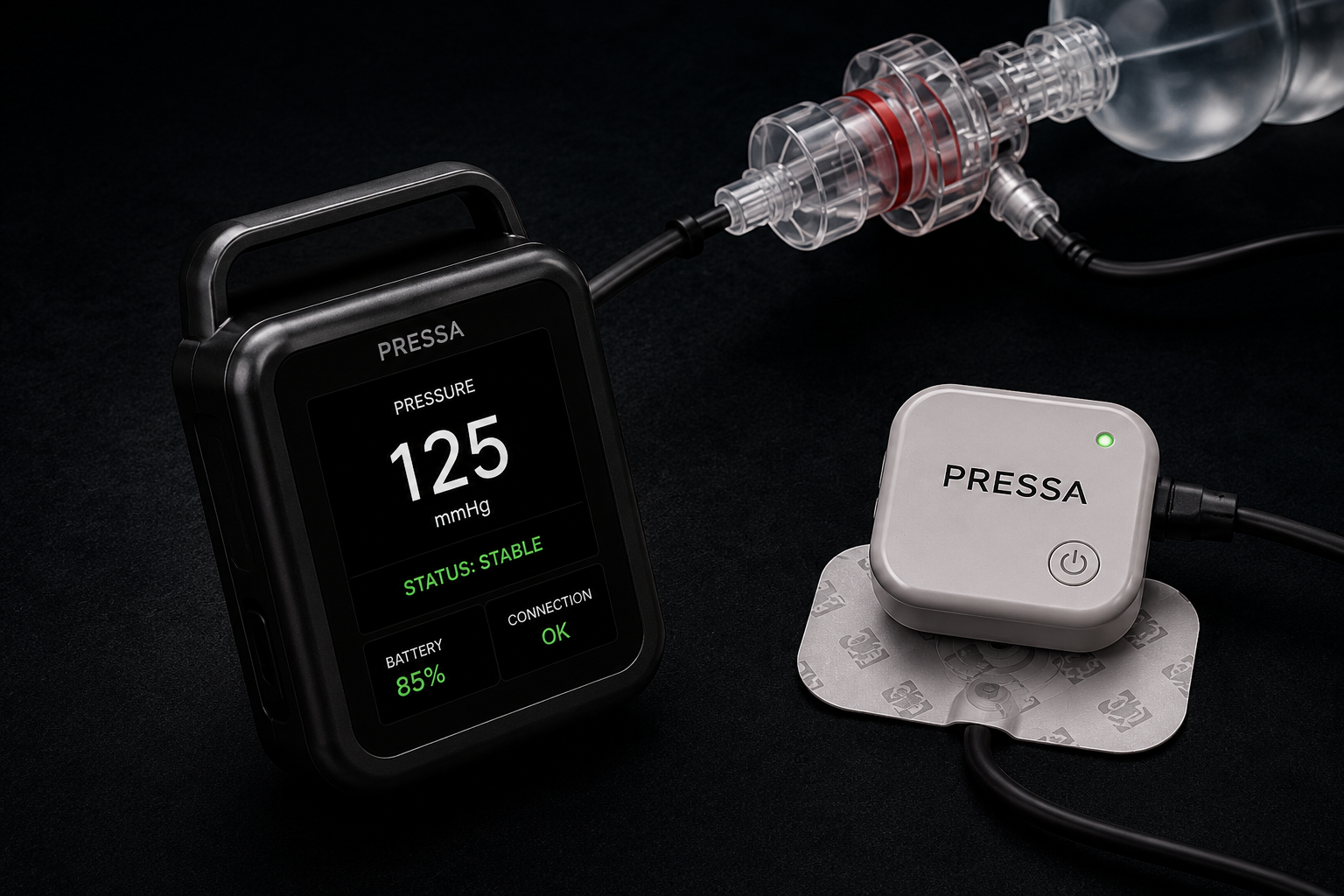
Concept render — not a final medical device. Details subject to change.
03 · Disposable head
Everything that touches the patient, once.
The disposable head is the pressure interface: a sealed, pre-calibrated cartridge that is opened at the point of care and discarded after use.
Single-use design removes the ambiguity of sterilization between patients. It also removes the mechanical wear and fatigue that would accumulate in a reusable pressure member.
We are designing the head to be compact, mechanically intuitive, and safe to deploy under stress. The exact geometry and material stack are part of our protected development work.
- 01Multi-shift battery life
- 02Harsh-environment sealing
- 03Rugged mechanical housing
- 04Field-swappable disposable head
- 05Software-upgradable safety logic
04 · Reusable controller
The durable brain of the system.
The controller is built to survive the conditions where PRESSA will be used: dust, vibration, temperature swings, and limited time to think.
It manages power, runs the embedded control loop, handles telemetry, and enforces the interlocks that prevent unsafe states. It is rechargeable, reusable, and designed to be serviced in the field.
We are keeping the control algorithms, sensor fusion methods, and firmware architecture under NDA — not because they are secret for secrecy's sake, but because they are the result of real engineering work that will be shared with the right partners.
05 · Pressure telemetry
Situational awareness without wires.
Once pressure is applied, the responder still needs to know what is happening. PRESSA's telemetry layer sends pressure state and system status to a local display that stays in the responder's hands or on their kit.
Real-time state
Continuous pressure and device status visible at a glance.
Local-only by default
Telemetry is designed to work without cloud connectivity or external servers.
Low-power link
Efficient wireless protocol chosen for battery life and reliability.
Encrypted transport
Data between controller and display is protected against tampering.
What we share, what we protect
No IP is revealed here. The right IP is revealed to the right partners.
This page describes the engineering direction, not the implementation. The schematics, material choices, sensor specifications, control algorithms, and firmware architecture are intentionally omitted.
If you are a trauma clinician, medical device engineer, manufacturing partner, or investor with a genuine interest in the platform, we are open to a deeper technical conversation under appropriate confidentiality.
Coming soon
Full engineering briefs are in the works.
We are preparing detailed subsystem briefs for mechanical engineering, embedded systems, controls, and signal processing. If you want to be notified when they are ready — or want to help shape them — get in touch.
Mechanical engineers · Embedded systems engineers · Controls engineers · Signal processing · Trauma clinicians