Technology
How we are building it.
The engineering detail behind PRESSA — platform, workflow, principles, and the questions we have not answered yet.
04 · The platform
A system, not a single device.
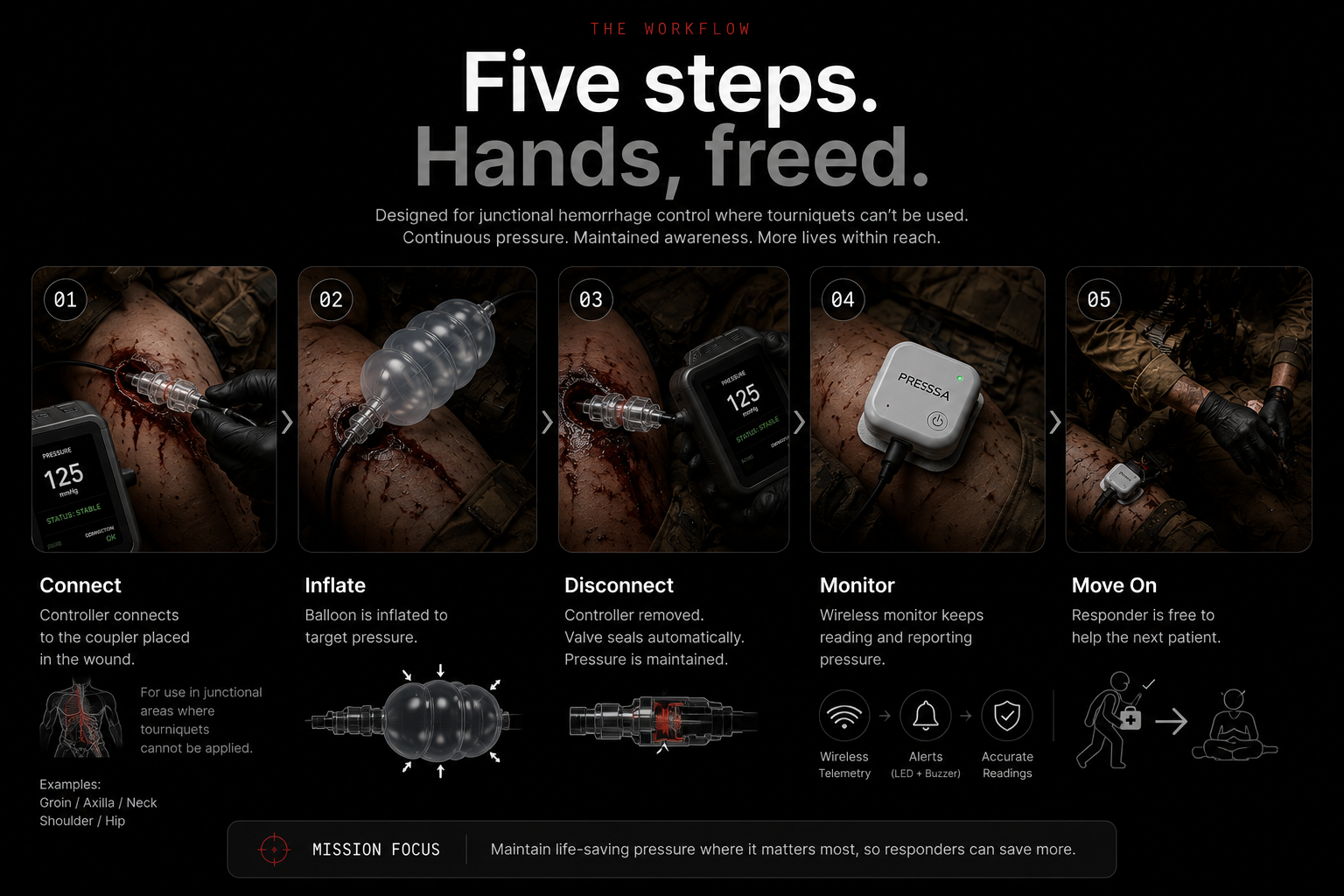
Hemorrhage control in the field is a workflow problem as much as a hardware problem. PRESSA is being designed as five layers that have to work together.
Reusable hardware. Power, control logic, safety limits.
Single-patient, sterile, designed for field handling.
Real-time control, guardrails, and clear feedback under stress.
Protocols and simulation built with the services that would use it.
Structured records from every use, feeding the next iteration.
Each layer is being developed and reviewed independently, so the approach can change without the mission changing.
A responder arrives.
Hands find the wound. Pressure holds.
Another patient needs help.
But the hands are already committed.
The technique hasn't changed in a century.
We think it's time.
The system
Every component.
Designed for one job.
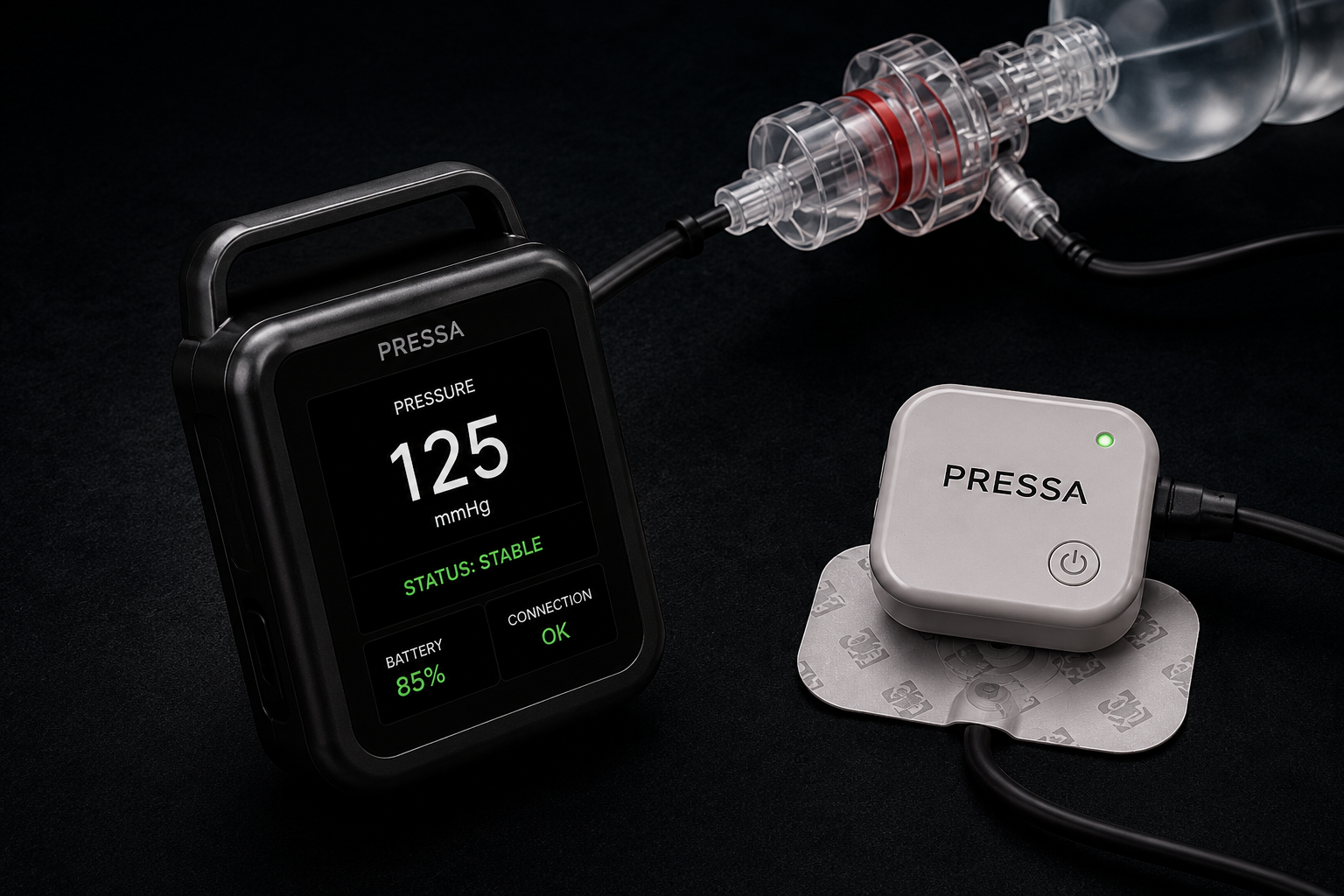
The brain of the system. Battery, pump, processor, and pressure logic in one machined housing.
- OLED display
- Precise pressure control
- Safety logic
- Field-ready housing
A medical-grade micro pump. Fast, quiet, accurate inflation.
- Fast inflation
- Quiet operation
- Precise pressure
- Compact
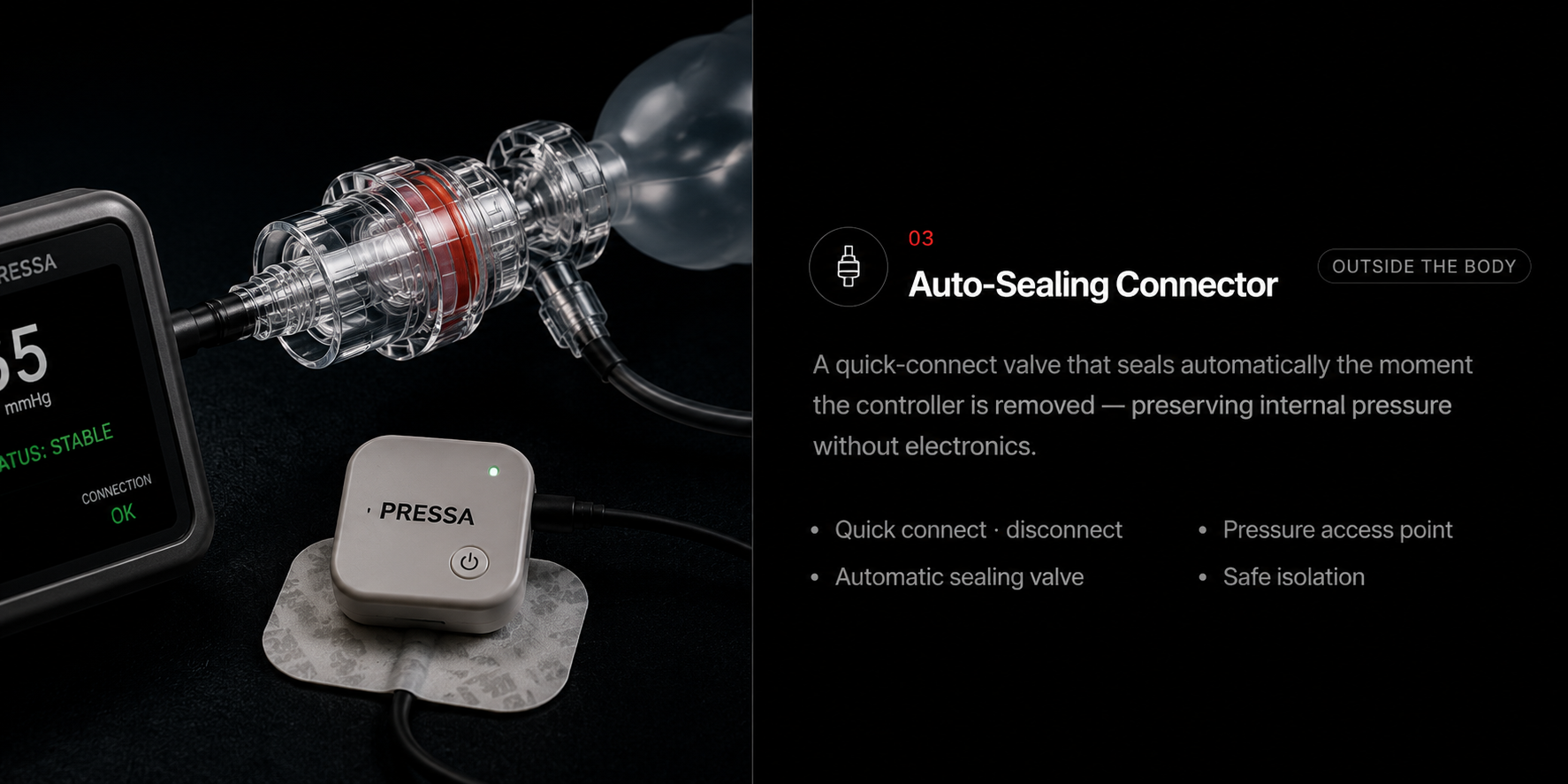
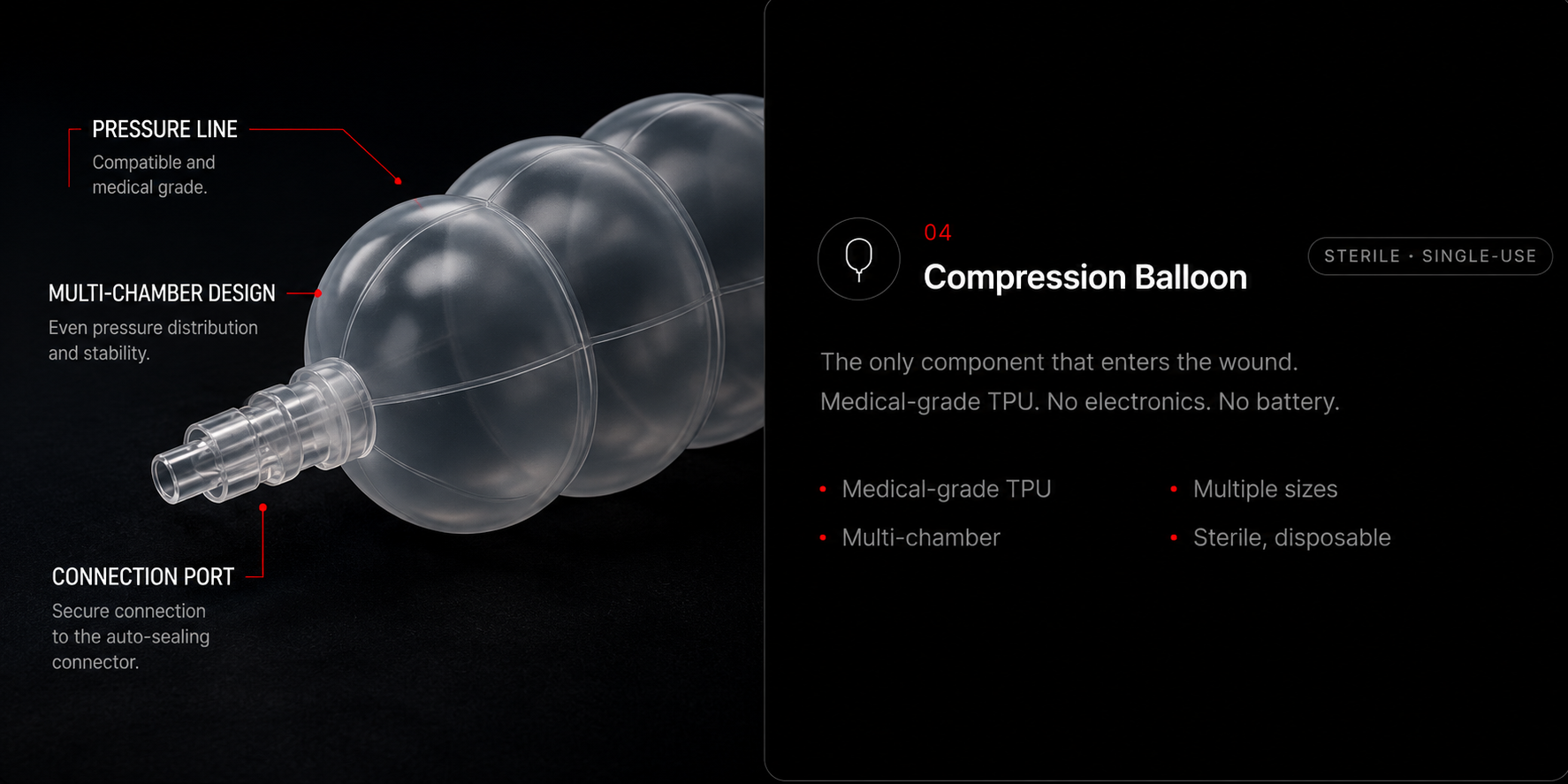
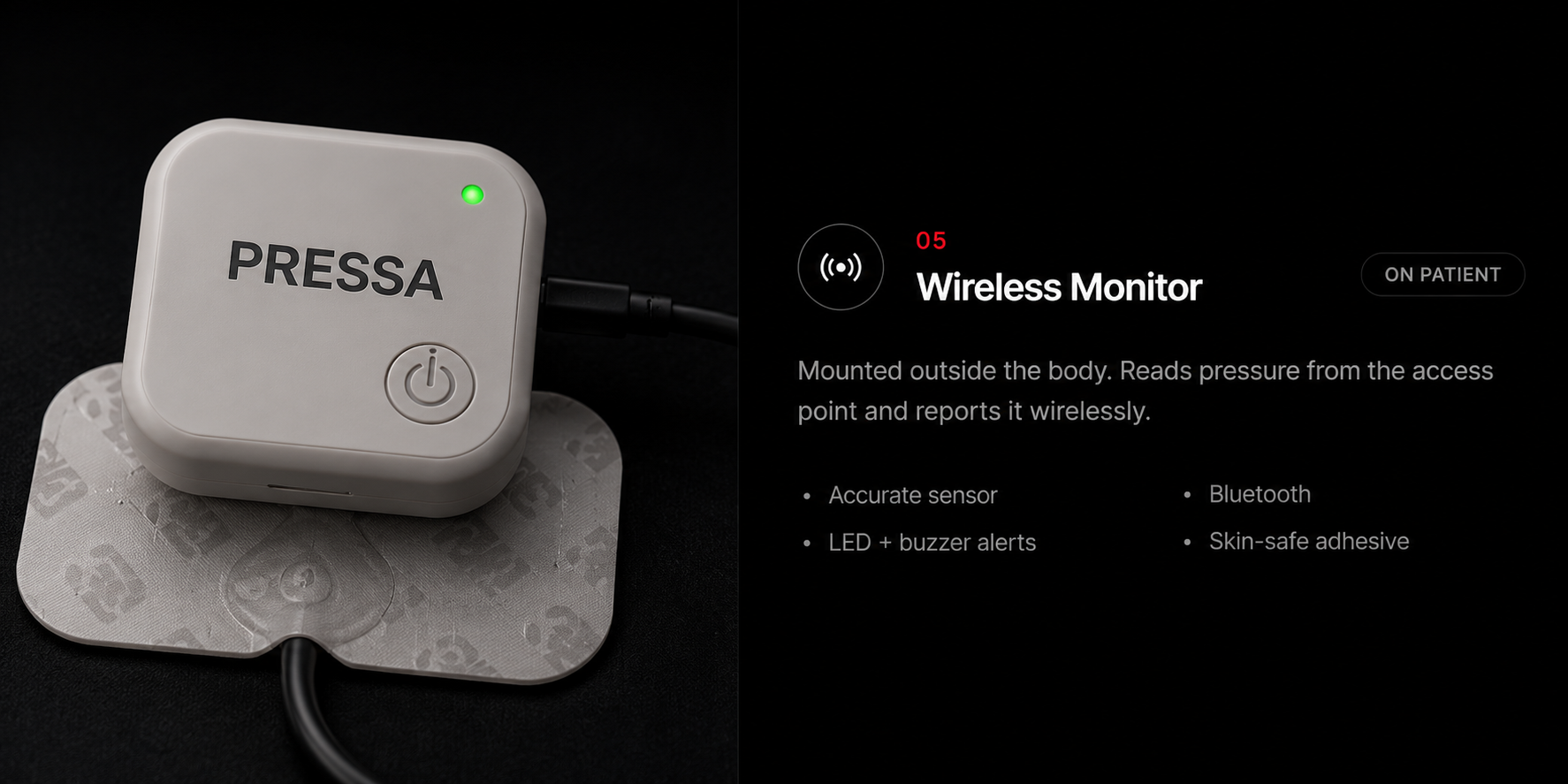
Display
Legible under pressure.
One number. One status. Nothing else.
Principles we won't compromise
Non-negotiables.
- 01Safety before speed.
- 02Evidence before marketing.
- 03Engineering before hype.
- 04Transparency over perfection.
- 05Responders first.
- 06Human judgment stays central.
- 07Medicine deserves humility.
The long view
Imagine ten years from now.
A responder arrives carrying not one device — but an ecosystem.
- 01Pressure
- 02Monitoring
- 03Awareness
- 04Communication
- 05Decision support
Everything connected. Everything designed around one mission — supporting the responder.
That future begins with PRESSA One.
Open development
Nothing hidden.
Nothing polished for effect.
Join us.
PRESSA journal
Latest updates.
Prototype progress. Medical interviews. Engineering decisions. Manufacturing. Lessons learned. Updated as we go.
- July 2026PRESSA founded.
The question that started it all.
- August 2026Engineering concept complete.
First full system architecture on paper.
- September 2026First medical interviews.
Trauma surgeons, EMS, military medics.
- October 2026Prototype architecture.
Mechanical layout and component sourcing.
- NextTo be written.
Frequently asked hard questions
The ones people
actually ask.
Why hasn't this been built before?
The pieces — miniature pressure sensors, compact batteries, low-power wireless, medical polymers — only recently matured together. Before that, the physics and the economics didn't line up.
How is PRESSA different from existing hemorrhage control devices?
Tourniquets, wound packs, and clamps all require sustained human attention or apply pressure indiscriminately. PRESSA is a system: apply controlled pressure, keep monitoring it wirelessly, free the responder to move on — with the option to intervene at any moment.
Will this replace trained responders?
No. Never. PRESSA is a tool that gives trained responders more capacity. Human judgment stays in the loop at every step.
Why build in public?
Because the people who will one day use this deserve to see how it's being built. And because feedback earlier means fewer regrets later.
Why take contact requests before a product exists?
We're not selling anything. We're inviting people — clinicians, engineers, responders — to help shape a mission at the point it can still be shaped.
What are you validating today?
Engineering architecture. Clinical workflow. Industrial design. Regulatory pathway. Prior art. We're documenting each as we go.
What's the biggest technical challenge?
Keeping the system safe, simple, and reliable when it's used at the worst moments of someone's day. Every design decision fights for those three things at once.
What could make PRESSA fail
Because pretending nothing can
would be dishonest.
Building a serious medical technology company means facing the things that could stop us. Naming them is the first step to addressing them.
- 01Technical feasibility
Every constraint — pressure control, sealing, wireless telemetry — has to hold under real trauma conditions, not just the bench.
- 02Clinical validation
Evidence has to show, honestly, that responders help more patients with the system than without it.
- 03Regulatory approval
FDA and equivalent bodies must be convinced the safety story is complete. That takes time and rigor.
- 04Manufacturing
Medical-grade production at reliable quality and reasonable cost is its own hard problem.
- 05Adoption
Even great tools fail if they don't fit real workflows. Training, procurement, and integration all have to click.
We're validating each of these — one step at a time, in public.
Join the mission
Join The Mission.
Become one of the first people following the development of what we hope becomes a new generation of trauma technology. Clinicians, responders, engineers, investors, potential partners — if you want to be part of this, we want to hear from you.